With the repeal of the Fairness Doctrine in 1987 under the Reagan administration, the way for media consolidation was opened up for broadcasters to control both the airwaves and the content on them. This resulted in an explosion of right-wing radio and the birth of conservative propaganda television like FOX News, changing the landscape of journalism and manufacturing consent in the American public. The same dynamics that left a crisis in the state of the news media have done much the same to Hip Hop, with an eerily striking similarity.
Thug Life, Right-Wing News and the Iraq War: How Big Media Manufactures Consent
On his 2000 Black On Both Sides, emcee Mos Def declared that “You know what's gonna happen with Hip Hop? Whatever's happening with us. If we smoked out, Hip Hop is gonna be smoked out. If we doin alright, Hip Hop is gonna be doin alright…Hip Hop is goin where we goin.”
Profound words. And for a long time I repeated them when I was often asked what I thought could be done about the state of Hip Hop. I would say if people want Hip Hop to change they had to demand better music. People had to support artists who put out better music, and not purchase albums of artists they found detrimental to Hip Hop overall. Change in the art would come, when a change in demand was made.
However, by his second album The New Danger in 2004, Mos Def’s tone had changed. Gone were the mantras that Hip Hop’s rebirth was going to be pushed along merely by a moral uplift in the people. Instead, the forces arrayed against the art form’s future are more sinister—“ Old white men is runnin’ this rap sh*t! Corporate forces runnin’ this rap sh*t!”
Some scoff when it is put forward that much of the derogatory rap lyrics and videos they see today is pushed by the industry. They label it a "conspiracy theory" and assert that artists who make a lot of money are hardly victims, but should instead take personal responsibility. I once thought along these lines. What I didn’t understand, what I could not connect, was that the same forces that limit Hip Hop to one dimensional themes of sex and violence are the very ones that threaten media overall. It is no conspiracy, but the way an institutionalized system that works for corporate profit rather than the public good operates. It is what happens when you stifle diversity and instead pander to expectations. And until this is understood, acknowledged and challenged, changing the face of Hip Hop will remain beyond our grasp. But rap music is not alone. A more popular form of expression has found itself stifled by the same dynamics—journalism. I offer the following analogy in three parts.
The Rise & Fall of the Fairness Doctrine
In 1949, the FCC adopted what came to be known as the Fairness Doctrine, a policy that designated station licensees as "public trustees," responsible for addressing controversial and contrasting issues of public importance. The key requirement of the Fairness Doctrine was that stations allowed opportunity for discussion of differing points of view, for the necessity of furthering the public good. For instance, if a radio station wanted to present conservative commentary, the Fairness Doctrine required they give equal and fair time to progressive/liberal commentary. Political candidates could demand equal time from radio and television. The Fairness Doctrine also worked as one of the checks against big media consolidation, recognizing that the airwaves belong to the people, not to corporate interests. This placed the Fairness Doctrine at continual odds with media broadcasters who sought to do away with government regulation, so that they would be beholden only to profit and not the public. As the saying goes, business is in the business of making money.
In the 1980s came the Reagan Revolution, and a major push for deregulation that would take the government out of the way of the broadcasters. Reagan’s FCC chair, Mark S. Fowler, was one such advocate. A former broadcast industry lawyer, Fowler had long made public his belief that broadcasters had no special responsibilities to democratic discourse or the public good. Instead, Fowler believed broadcasters should be concerned with the bottom line. “The perception of broadcasters as community trustees should be replaced by a view of broadcasters as marketplace participants,” he would state. By placing a broadcast industry lawyer in charge of the FCC, it was not long before courts found that the Fairness Doctrine did not need to be enforced. In a hurried attempt to save what some defined as “a struggle for nothing less than possession of the First Amendment: Who gets to have and express opinions in America,” the Congress passed a bill to make the Fairness Doctrine into law. However, President Reagan vetoed the legislation. A similar veto threat doomed another attempt under George H.W. Bush in 1991.
How a Shift in the Media Helped Shift Public Opinion
The results of the repeal of the Fairness Doctrine were stunning. Already not enforced since the mid 1980s by an FCC in the pocket of big media, with the doctrine out of the way broadcasters found themselves free to do with the airwaves much as they pleased. By the 1990s a series of laws allowing for media consolidation placed much of what we hear or see into the hands of fewer owners. Alongside all of this was the rise of right-wing conservative radio. As Jeffrey Chester, executive director of the Center for Digital Democracy, noted:The rise of conservative talk radio is directly linked to the absence of the Fairness Doctrine. Rush Limbaugh, Sean Hannity and the myriad of shrill right-wing talk jocks are immune from having to provide even a modicum of balanced perspective. Media consolidation has greatly fueled the problem, creating powerful station chains with a distinct political perspective, such as Clear Channel and Sinclair Broadcasting. While on cable and satellite networks, Rupert Murdoch's FOX News Channel offers conservative commentary thinly disguised as journalism.
The power of this limited media cannot be overstated. By shutting out nearly all forms of liberal radio, the public airwaves become dominated by right-wing commentary that enabled the monumental Republican Revolution of 1994 which culminated in the 2000 election of George W. Bush. Furthermore, channels like FOX News began to alter the very landscape of journalism. As noted by Robert Greenwald’s documentary Outfoxed: Rupert Murdoch’s War on Journalism, by pushing sensationalist headlines, featuring mostly pro-conservative commentators, race-bating, creating scapegoats and fostering an atmosphere that reduced news to sex, gossip and one-dimensional opinions, FOX News slowly pushed competing broadcasters closer to its own style—favoring profits over journalism. Frightened by its success and envious of its ratings, other news media outlets became increasingly more conservative, more dedicated to gossip stories and less interested in hard-hitting investigative journalism. Instead of challenging or questioning power, they became increasingly subservient to it.
After 9/11 this turn in the media became even more glaring. With FOX News and conservative radio leading the way, the manipulation of American fear and the appeal to jingoism became commonplace. Big news media became a willing tool of the White House, offering little in the way of journalistic criticism. During the lead up to the invasion of Iraq, the media practically “rolled over” for the Bush administration, becoming a mouth-piece in making the case for war. It was not that “alternative” voices didn't exist. On independent and underground news sources, everything from the charge of WMDs to the claims of a Saddam Hussein-Al-Qaeda link was challenged and even disproved. Tens and hundreds of thousands marched in the streets against impending war. Yet from FOX News to CNN to the NY Times, the face of mainstream media was either indifferent to these voices or decidedly pro-war. Anti-war journalism and activists were either marginalized or shut out altogether from the discussion. Not surprisingly, the majority of the American public—with limited diverse options in the way of information—turned pro-war, with some 3 out of 4 supporting military action against Iraq. Those that were fed a diet of strict conservative media like FOX News were the most prone to believe, falsely, that Iraq and 9/11 were linked. It was only after Iraq turned disastrous, and the mainstream news media was opened up to more diverse opinions, that a shift in portrayal of the war took place. Consequently, another vast shift in American popular opinion began to take place, this time more to the center and left, resulting in plummeting poll numbers for the Bush White House, a change of control in Congress and a solid majority who not only think the war was a mistake, but now want it to end.
How “Old White Men” Run This Rap Sh*t
The experience of the news media under media consolidation bears similarities to Hip Hop’s current one-dimensional state. The rise of “thug” rap coincided neatly with the increase of control by major corporations. Pushing exploitative tales of the “ghetto,” and laced with sex and violence—that indulge heavily in racial stereotypes—media termed “gangsta” rap became commercially viable to corporations more concerned with the bottom line than with art. With such financial success, and racial expectations, this one-dimensional face of Hip Hop became marketed as mainstream. The continued consolidation of media slowly strangled any form of diversity. As Professor Akilah Folami noted in a March 2007 article:The Telecommunications Act of 1996 has strengthened corporate control of radio stations and has allowed for the commodification of Hip Hop music. Corporate control of radio has stifled social commentary and diversity present in “old-school” Rap and Hip Hop. Instead, corporate control has encouraged the proliferation of Gangsta Rap and the Gangsta Image, which has become the defacto voice of contemporary Hip Hop culture.
As noted in a previous essay, author Nick Chiles recounted the same dynamics behind the rise and dominance of black “street literature.” As “Street Lit” became pushed as mainstream black culture by the publishing industry, it steadily began to replace any other form of black literature. That there is a market for it should not be surprising. Sensationalist topics like sex and violence will sell books or music, as easily as it sells gossip stories about Anna Nicole Smith. Consumers further bought into the trend, as it became the most common black literature offered. A proliferation of books of this type took place as authors attempted to cash in on this trend, or were pushed in that direction. In ways similar to how publishers helped manufacture the demand of “Street Lit, and how corporations manufactured consent in the news media, the popularity of “thug” rap was manufactured by marketing a single type of music and limiting the space for differing genres.
Today activists for diversity in journalism are increasingly pushing to limit further media consolidation and for some reintroduction of the Fairness Doctrine, so that news is made available in varied formats. In the wake of the Don Imus controversy, there is even fear in conservative and right-wing radio, television and print journalism, that a return to the Fairness Doctrine is on the horizon. In reality, the Democratic Congress is not poised to take up the issue, and there will have to be many more campaigns, rallies and more before it appears on their radar. Nevertheless, the momentum is there. A similar movement to end the one-dimensional depictions in Hip Hop is needed, where something akin to a Fairness Doctrine can be implemented on the corporate distributors and broadcasters of black entertainment media. Otherwise we will continue to have a music industry that merely manufactures consent and dictates the face of black culture.
Read the other two essays in this Series:
Sex, Guns & Violence: Why Hip Hop is All-American
Their Eyes Were Watching Smut: Turning Pornography into Black Culture
For more on the Fairness Doctrine and the News Media, see the following:
Time For a Digital Fairness Doctrine – Jeffrey Chester
Politics & Economy- Big Media- Billy Moyers, NOW
The Fairness Doctrine- Why We Need it Back – Steve Rendall
How the Media Bought the War
Thursday, April 19, 2007
Thug Life, Right-Wing News and the Iraq War: How Big Media Manufactures Consent


Sunday, April 15, 2007
Bad Rap: Racist German Army Film Blamed On Hip Hop?
A recent video clip of a German army instructor ordering a soldier to scream expletives and shoot at imaginary blacks from the Bronx, has caused outrage. Apologies have been made and there's an investigation into the bizarre incident. Yet, somehow, Hip Hop has been fingered as a culprit. Is this a legitimate charge? Or in the wake of Don Imus, are we yet again looking at an insult in search for a scapegoat? A televised cell phone video clip of a German army instructor ordering a soldier to envision African Americans from New York's Bronx borough as he fires a machine gun and yells obscenities during a military training session is igniting outrage in Europe and America. The video shows an instructor and a soldier in camouflage uniforms in a forest. The instructor tells the soldier, "You are in the Bronx. A black van is stopping in front of you. Three African-Americans are getting out and they are insulting your mother in the worst ways. … Act." A laugh can be heard on the recording. The instructor adds, "Before each shot, I want to hear a 'motherf——-!'" A German TV reporter who covers the military told ABC News that parts of American popular culture may be largely to blame for the racist behavior of the German soldiers. "There are quite a lot of [American] B movies or hip-hop songs where black people, Afro Americans, are portrayed as gangsters, are portrayed as criminals," said Carsten Lueb of the German NTV network. "Some people here in Germany they take it for real, not knowing that is completely wrong."
Racist German Army Clip Targets N.Y. Blacks- Hip Hop Takes the Rap
Was watching ABC News this evening and saw the following report:
So I'm thinking, okay. After the Don Imus affair, the news media "discovered" racism sometime last week. They'll treat it like a new phenomenon for a few days, and we'll move on to the next Anna Nicole Smith type story. What I wasn't prepared for, was a scene close to the end.
The soldier begins to fire his machine gun at the imaginary blacks and screams out 'motherf——-!" afer each round.
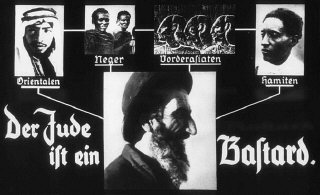
Oh okay. I get it, this is now part of the era of A.D.I. (After Don Imus). Hip Hop is now to blame for racism in Germany. The same Germany that gave us the Third Reich and the most extreme ideologies of white supremacy the world has yet seen. The Germany where the 20,000 to 30,000 blacks unfortunate enough to live under Nazi rule faced what the US Holocaust Museum termed "isolation...persecution, sterilization, medical experimentation, incarceration, brutality, and murder." The Germany responsible for the extermination of 6,000,000 Jews portrayed as some inferior "bastard offspring" of Africans and Asians. The Germany with a brutal and racist colonial legacy in Africa, including the Herero Massacre. The Germany where racist attacks (against blacks and others) had soared to over 40% by 2001; an Ethiopian-born man was beaten into a coma last April by a white mob. The Germany where black soccer players are taunted by thousands of fans who engage in "monkey chants" and throw bananas (part of a European continent wide derogatory ritual) when they enter on to the field. That's the Germany that now gets to blame Hip Hop for its racist sins.
Well, this must be a milestone in the history of creating scapegoats and irony. Even if one allows for the obvious reality that negative images of blacks is to blame for this incident, why lay it so easily at the feet of Hip Hop? Germany has a long history of Hip Hop, most of which is greatly divorced from "thug" rap. German Hip Hop has developed for such a time, that it now has its own indigenous sounds, beats, social movements and feel. There's hardly a need to form an image of Hip Hop based on "black criminals" from the Bronx when there's exposure to the creative diversity of indigenous German Hip Hop. Besides, of all the scary boogey-men the German army will have to face in the world, how do black residents of the Bronx skyrocket to the top? Did a group of blacks recently settle and form the ominous Republic of "Bronx-istan" somewhere near the Sudetenland?
Today Germany has a well established black community, the Afrodeutsche, who are a thriving part of modern German society. So in many ways, the country has come a long way from its past. And many of its citizens, black, white and Asian, can appreciate the full complexity of "The Bronx"--including the culture of Hip Hop that has been allowed to flourish on German soil. Incidents like this however, along with many others, show that Germany still has a long way to go on matters of race. Best to deal with that, rather than point a finger at Hip Hop.
Friday, April 13, 2007
The Martyrdom of Don Imus or The Devil Wears Hip Hop
Even in his demise talk show host "nappy-headed hos" Don Imus has attained a form of popular martyrdom. Read any of the many comment boards or blogs or gauge the reaction from commentators and regular citizens alike, and Imus is painted as a scapegoat—a sacrificial lamb (albeit a tainted one) that was vilified by a hypocritical black lynch mob that does not speak out equally against the use of derogatory language towards black women in rap music. Black commentator Earl Ofari Hutchinson even advocates that Don Imus is rapper Snoop Dogg’s “Frankenstein Monster." But did Don Imus really die for Hip Hop's sins? Or is the media elite protecting one of their own in order to restrict and limit our discussion? Even in his demise talk show host Don Imus has attained a form of popular martyrdom. Read any of the many comment boards or blogs or gauge the reaction from commentators and regular citizens alike, and Imus is painted as a scapegoat—a sacrificial lamb (albeit a tainted one) that was vilified by a hypocritical black lynch mob that does not speak out equally against the use of derogatory language towards black women in rap music. Imus had as much to say. "That phrase [nappy-headed hos] originated in the black community….I may be a white man, but I know that these young women and young black women all through that society are demeaned and disparaged and disrespected…by their own black men and that they are called that name." This defense has been cited repeatedly by defenders of Imus, and by those who assert it is rap music that is to blame for his slur. Increasingly conservative commentator Earl Ofari Hutchinson even advocates that Don Imus is rapper Snoop Dogg's "Frankenstein Monster." For Imus, a great deal was tolerated by CBS and MSNBC for a long time. But unlike Snoopp Dogg and the other purveyors of derogatory and sexist "thug" rap, or the radio landscape of insensitive commentary by Rush Limbaugh, Michael Savage and Laura Ingrams, Don Imus was able to have a program on mainstream television outlets that reached millions of viewers. Unlike the explicit drug-dealer glorifying Young Jeezy or the violent fictional mob boss Tony Soprano, Imus interviewed members of the media elite, presidential candidates, influence peddlers, and more. 50 Cent is derogatory in nearly every aspect of his lyricism, no doubt. But much like soft-core porn stars on Cinemax, he and other pushers of smut and violence, aren't afforded these privileges. Imus was. And when he crossed that line—wanting his cake and eat it too—he fittingly had his "ho" card pulled. Special thanks to Media Matters.org for the invaluable information.
The Martyrdom of Don Imus
or
The Devil Wears Hip Hop 
A Martyr and the Devil ?
However there is a glaring problem with the impending martyrdom of Don Imus—it rests on a series of omissions.
"Nappy Headed Hos:" Chances are if you heard the news story repeatedly, you mostly got the abridged version. Here's the larger context. Imus began by saying the women on the Rutgers team were some "rough girls" with "tattoos." It is the executive producer of the show Bernard McGuirk who interrupts to say, "Some hard-core hos." Imus responds, "That's some nappy headed-hos" and begins to compare them unfavorably to the women of the Tennessee team. McGuirk then jokes, "The Jigaboos vs the Wannabes," alluding to Spike Lee's School Daze. He and Imus go on to talk about the lack of femininity of the Rutgers players. A fellow regular on the show, sports announcer Sid Rosenberg, adds "It was a tough watch. The more I look at Rutgers, they look exactly like the Toronto Raptors." This larger context brings up an entirely different angle. What we have here are several white men indulging in an age old intersection of sexism and racism that degrades black women as either sexually exotic or physically unattractive—at least in comparison to white women. Put together, along with words like "Jigaboo," we have a story more offensive than the "nappy headed hos." But the media inexplicably leaves this context on the cutting room floor. And now our conversations and debates are restricted to, "well don't rappers use ho' too?" and "why is Imus being singled out?" Perhaps it's because "Jigaboo" wouldn't fit into the "it's the rappers fault" theme.
"Bitch is Going to be Wearing Cornrows:" Executive producer Bernard Guirk, who instigated the disastrous remarks about the Rutgers team but goes unmentioned in news stories, just weeks ago made comments that were even more inflammatory. Just one month ago, on the March 6, 2007 edition of MSNBC's Imus in the Morning, executive producer Bernard McGuirk stated that Sen. Hillary Rodham Clinton (D-NY) was "trying to sound black in front of a black audience" when she gave a speech on March 4 in Selma, Alabama, to commemorate the infamous 1965 "Bloody Sunday" Civil Rights march. McGuirk added that Clinton "will have cornrows and gold teeth before this fight with [Sen. Barack] Obama [D-IL] is over." Earlier in the program, in reference to Clinton's speech, McGuirk had said, "Bitch is gonna be wearing cornrows." McGuirk also said that Clinton will be "giving Crips signs during speeches," alluding to the infamous Los Angeles-based street gang. The entire time McGuirk is stating this, denigrating an important moment in Civil Rights history, Imus jokes along, never stating the words himself but urging on the comments and certainly never calling McGuirk out for them. Although all of this happened just a month ago, and McGuirk was intricately involved in this current controversy, somehow he escapes mention in most media depictions of the story. So, again, we are presented with no context by which people can make a sound examination of both the initial controversial event and the very recent history of the show.
"Whitey plucked you from the jungle"…and "took away your spears:" Bernard McGuirk made those statements just one month ago, on the same March 6, 2007 edition of Imus in the Morning mentioned above. He was doing a mocking imitation of African-American poet Maya Angelou. Don Imus, playing along, urges McGuirk to do his imitation of "that woman…the poet" who another guest (Rob Bartlett) compares to "Esther Rolles from Good Times." McGuirk eagerly indulges with a poem where he jokes about slavery and the stereotype of blacks being lazy: "Whitey plucked you from the jungle for too many years, Took away your pride, your dignity, and your spears, With freedom came new woes, Into whitey's world you was rudely cast, So wake up now and go to work? You can kiss my big black ass." It's only after a good laugh that Imus playfully warns McGuirk to stop because "I don't need any more columns."
"Bernard McGuirk is there to do 'nigger' jokes:" That was a quote attributed to Don Imus by producer Tom Anderson in 1998. Imus was speaking to CBS journalist Mike Wallace. At first denying that he had said so, when called to the carpet about it by Wallace, Imus laughed and admitted it—but said it was "off the record."
"That Animal [Venus Williams]….She's an Animal:" That was sports announcer Sid Rosenberg, a regular guest on the Imus show in June of 2001, talking about tennis player Venus Williams. Rosenberg was also part of the crew involved in this latest controversy [comparing the Rutgers women to a male basketball team] who disappeared from the headlines. "That animal…" Rosenberg says of Venus Williams in her appearance at the 2001 U.S. Open, "She's an animal." Commenting on the Williams sisters together, Rosenberg says, "I can't, I can't even watch them play anymore. I find it disgusting…They should play with the men." In his normal way, Imus calls this stupid, but allows Rosenberg to continue with his disparaging remarks. "A friend, he says to me, 'You know what,' he goes, 'Listen, one of these days you're going to see, find Venus and Serena Williams in Playboy.' I said, 'You gotta better shot at National Geographic." To this Imus responds, "That'll be fine." After a small furor erupted over this, Imus fired Rosenberg but re-hired him within a week after an apology was made on the air. Rosenberg would insist that his comments about the Williams sisters weren't racist, "just zoological." After a string of later offenses, including referring to Palestinians as "stinking animals" and mocking singer Kylie Minogue's cancer, Rosenberg was let go in 2005. However earlier this year he returned, and picking up on his old habit of demeaning women, especially black women, he referred to the Rutgers team as "a tough watch" and that "they look exactly like the Toronto Raptors."
As the above illustrates, the Imus show's problems with gender and race are not new. It was part of a larger pattern, one that had long been noted by others like Media Matters.org or FAIR, though glaringly overlooked by the mainstream media and tolerated by both CBS and MSNBC. Imus often walked a delicate tightrope, never straying directly into the most inflammatory remarks himself, but encouraging and allowing it from both Sid Rosenberg and Bernard McGuirk (the one hired to do "nigger jokes."). A May 30, 1996, column in The News & Observer of Raleigh, North Carolina, protesting the show's treatment of Maya Angelou, summed it up thusly:
In 2000, the show's treatment of blacks became so dismal, that African-American Chicago Tribune columnist Clarence Page appeared on the show and asked Imus to pledge to "cease all simian references [to] black athletes" and "references to noncriminal blacks as thugs, pimps, muggers, and Colt 45 drinkers." Imus responded, "I promise to do that." Page also asked that Imus put an end to black minstrel-like "Amos 'n Andy cuts," to stop the "comparison of New York City to Mogadishu," and cease with "all parodies of black voices." Imus joked, "I think Bernard should be doing this," but accepted the pledge, only to break it almost immediately.
And so the show has long operated. What was different this time was that Imus broke his own rule. Rather than letting McGuirk and Rosenberg make derogatory comments for him, he jumped into the fray, calling the Rutger's team "nappy headed hos." At first refusing to recant, when the heat was turned up he invited himself onto activist Rev. Al Sharpton's show to apologise. And it wasn't long before the media elite--from The Boston Globe's Tom Oliphant to Newsweek's Howard Fineman--rallied around him. However this time it wasn't enough. Key advertisers began to abandon him. MSNBC and CBS, perhaps fearing of opening a Pandora's Box into the show's sordid history, decided to finally cut ties with Imus and take their losses.
This has happened before. Right wing radio host Rush Limbaugh was invited in the summer of 2003 as a Sunday sports announcer for ESPN, even despite a long history of insensitive racial comments. By October of that year Limbaugh found himself mired in controversy when he made disparaging comments about black quarterback Donavan McNabb. Fearful of bad publicity, ESPN jettisoned Limbaugh quickly. Why was Limbaugh axed for what was normal fare on his radio show? Because what is usually allowed in right-wing radio commentary cannot be tolerated on a big name mainstream television station like ESPN.