Part of the idea of "Fairness" 4 Hip Hop, is a need for equity in analysis and portrayal of the culture. While Hip Hop does indeed have its fair share of misogynist and violent lyrics, such things must be placed into the larger societal context. As pointed out in previous articles, violence and sexism are part of the American reality. Hip Hop was not born somewhere in outer space--it was conceived, birthed and nurtured right here. Yet, as Cornell West notes, the criminalization of black males in American media and popular thought results in a bias towards Hip Hop as some aberration. In the following article Dr. Edward Rhymes points out the hypocrisy of painting Hip Hop as the eternal "bogeyman in blackface," while neglecting the institutional sexism and racism that dominates American mainstream culture.
Caucasian Please! America's Cultural Double Standard For Misogyny & Racism
By Dr. Edward Rhymes
Black Agenda Report
Despite the firing of Don Imus, corporate media continue to attempt to divert attention from long-established institutional sexism, in order to depict Black youth culture as the vector of the disease. The American reality is one of pervasive celebration of violence, in general, and violence against women, in particular -- a white cultural invention. Black rappers, who are owned and controlled by white corporations, did not create this culture of violence and misogyny, but are made the scapegoats for a much deeper national social crisis -- a landscape in which "The Godfather" and "Goodfellas" are revered as "classic" films.
Introduction
In this composition I will not be addressing the whole of hip-hop and rap, but rather hardcore and gangsta rap. It is my assertion that the mainstream media and political pundits -- right and left -- have painted rap and hip-hop with a very broad brush. Let me be perfectly clear, hardcore and gangsta rap is not listened to, watched, consumed or supported in my home and never has been. I will not be an apologist for anything that chooses to frame the dialogue about Black women (and women in general) and Black life in morally bankrupt language and reprehensible symbols.
In the wake of MSNBC's and CBS's firing of Don Imus, the debate over misogyny, sexism and racism has now taken flight -- or submerged, depending on your point of view. There are many, mostly white, people who believe that Imus was a fall guy and he is receiving blame and criticism for what many rap artists do continually in the lyrics and videos: debase and degrade Black women. A Black guest on an MSNBC news program even went as far as to say, "Where would a 66 year-old white guy even had heard the phrase nappy-headed ho" -- alluding to hip-hop music's perceived powerful influence upon American culture and life (and apparently over the radio legend as well) -- and by so doing gave a veneer of truth to the theory that rap music is the main culprit to be blamed for this contemporary brand of chauvinism.
However, I concur with bell hooks, the noted sociologist and black-feminist activist who said that "to see gangsta rap as a reflection of dominant values in our culture rather than as an aberrant 'pathological' standpoint, does not mean that a rigorous feminist critique of the sexist and misogyny expressed in this music is not needed. Without a doubt black males, young and old, must be held politically accountable for their sexism.
Yet this critique must always be contextualized or we risk making it appear that the behavior this thinking supports and condones -- rape, male violence against women, etc. -- is a black male thing. And this is what is happening. Young black males are forced to take the 'heat' for encouraging, via their music, the hatred of and violence against women that is a central core of patriarchy."
There are those in the media, mostly white males (but also some black pundits as well), who now want the Black community to take a look at hip-hop music and correct the diabolical "double-standard" that dwells therein. Before a real conversation can be had, we have to blow-up the myths, expose the lies and cast a powerful and discerning light on the "real" double-standards and duplicity. Kim Deterline and Art Jones in their essay, Fear of a Rap Planet, point out that "the issue with media coverage of rap is not whether African Americans engaged in a campaign against what they see as violent, sexist or racist imagery in rap should be heard -- they should. ...[W]hy are community voices fighting racism and sexism in mainstream news media, films and advertisements not treated similarly?
The answer may be found in white-owned corporate media's historical role as facilitator of racial scapegoating. Perhaps before advocating censorship of a music form with origins in a voiceless community, mainstream media pundits should look at the violence perpetuated by their own racism and sexism."
Just as the mainstream media and the dominant culture-at-large treats all things "Black" in America as the "other" or as some sort of science experiment in a test tube in an isolated and controlled environment, so hardcore rap is treated as if it occurred in some kind of cultural vacuum; untouched, unbowed and uninformed by the larger, broader, dominant American culture. The conversation is always framed in the form of this question: "What is rap's influence on American society and culture?" Never do we ask, "What has been society's role in shaping and influencing hip-hop?"
Gangsta and hardcore rap is the product of a society that has historically objectified and demeaned women, and commercialized sex. These dynamics are present in hip hop to the extent that they are present in society. The rapper who grew up in the inner-city watched the same sexist television programs, commercials and movies; had access to the same pornographic and misogynistic magazines and materials; and read the same textbooks that limited the presence and excluded the achievements of women (and people of color as well), as the All-American, Ivy-league bound, white kid in suburban America.
It is not sexism and misogyny that the dominant culture is opposed to (history and commercialism has proven that). The dominant culture's opposition lies with hip-hop's cultural variation of the made-in-the-USA misogynistic themes and with the Black voices communicating the message. The debate and the dialogue must be understood in this context.
Popular Culture's Duplicitous Sexism & Violence In Black And White
In a piece I penned a couple of years ago, I endeavored to point out the clear ethnic and racial double-standards of the media and society as it pertains to sex and violence. My assertion was, and remains to be, that the mainstream media and society-at-large, appear to have not so much of a problem with the glorification of sex and violence, but rather with who is doing the glorifying. In it I stated that "if the brutality and violence in gangsta rap was truly the real issue, then shouldn't a series like The Sopranos be held to the same standard? If we are so concerned about bloodshed, then how did movies like 'The Godfather,' 'The Untouchables' and 'Goodfellas' become classics?"
I then addressed the sexual aspect of this double-standard by pointing out that "Sex & The City," a series that focused, by and large, on the sexual relationships of four white women, was hailed as a powerful demonstration of female camaraderie and empowerment.
This show, during its run, was lavished with critical praise and commercial success while hip-hop and rap artists are attacked by the morality police for their depiction of sex in their lyrics and videos. The don't-blink-or-you'll-miss-it appearance of Janet Jackson's right bosom during [a] Super Bowl halftime show. ... caused more of a furor than the countless commercials that (also aired during the Super Bowl) used sex to sell anything from beer to cars to gum. Not to mention the constant stream of commercials that rather openly talks about erectile dysfunction medication."
The exaltation of drugs, misogyny and violence in music lyrics has a history that predates NWA, Ice Cube, Ice T and Snoop Dogg. Elton John's 1977 song "Tickin," was about a young man who goes into a bar and kills 14 people; Bruce Springsteen's "Nebraska," featured a couple on a shooting spree, and his "Johnny 99," was about a gun-waving laid-off worker; and Stephen Sondheim's score for "Assassins," which presented songs mostly in the first person about would-be and successful presidential assassins.
Eric Clapton's "Cocaine" and the Beatles' "Lucy in the Sky with Diamonds" (LSD) as well as almost anything by Jefferson Airplane or Spaceship. Several songs from "Tommy" and Pink Floyd's "The Wall" are well known drug songs. "Catholic girls," "Centerfold," "Sugar Walls" by Van Halen were raunchy, misogynistic, lust-driven rock refrains.
Even the country music legend Kenny Rogers in his legendary ballad, "Coward Of The County," spoke of a violent gang-rape and then a triple-homicide by the song's hero to avenge his assaulted lover. Marilyn Manson declared that one of the aims of his provocative persona was to see how much it would take to get the moralists as mad at white artists as they got about 2LiveCrew. He said it took fake boobs, Satanism, simulated sex on stage, death and angst along with semi-explicit lyrics, to get the same screaming the 2LiveCrew got for one song. Manson thought this reaction was hypocritical and hilarious.
Other artists like Kid Rock have won commercial success easily and faced only minor battles with the FCC with songs such as: "F**k U Blind. Consider the lyrics of Kid Rock, whose piercing blend of hard rock, metal and misogyny has sold millions of records:
Now if you like the booty come on fellas show it This is your last verse to wax so why would you blow it And if the ladies if you are tired of a man on your fanny Then f--k you go home and watch the tube with granny ... Just look at all the girls that are dying to get some Man, just don't be a wussy
And I'll guarantee you could get a piece of p----
Likewise, consider the lyrics of the rock song "Anything Goes" from Guns 'N Roses:
Panties 'round your knees
With your ass in debris
Doin' dat grind with a push and squeeze
Tied up, tied down, up against the wall
Be my rubbermade baby
An' we can do it all.''
The bad-boy, outlaw rockers have traditionally and consistently been marketed and packaged as misogynistic. Artists and groups such as David Lee Roth, Kid Rock, Metallica, Uncle Kracker, to name a few.
Take note of the following list of rock groups and some of the albums and songs that they have released: American Dog (released an album in 2001 titled, Six Pack: Songs About Drinkin & F**kin), Big C*ck (released an album in 2005 titled: Year Of The C**k -- with titles like Bad Motherf***er, Hard To Swallow & You Suck The Love Out Of Me) W.A.S.P. (released an album in 1983 titled: Animal: F**ks Like A Beast, an album in 1997 K.F.D.: Kill, F**k, Die), Faster Pussycat (released album in 1992 titled Whipped -- with a song titled Loose Booty, 2001 titled: Between The Valley Of The Ultra P**sy, 2006 album titled: The Power Of The Glory Hole -- with such titles as Porn Star and Shut Up & F**k), Lynch Mob (released an album in 2003 titled: Evil: Live -- featuring the song (Tie Your Mother Down) and a compilation album released in 2003 titled C**k'N'Roll: The World's Sleaziest Rock Bands -- displaying "hits" like: Dog Sh*t Boys -- One Minute F**k, Sagger -- The Closest I've Ever Come To F**king Myself and Hellside Stranglers -- Motherf***ers Don't Cry.
In an article by Dana Williams titled, BEYOND RAP: Musical Misogyny, Ann Savage, associate professor of telecommunications at Butler University stated: "It's the repetitiveness of the messages, the repetitiveness of the attitudes, and it builds on people...." "People say rap is dangerous. Yes, rap music does have misogyny, but there has always been an objectification and misogyny against women in music," said Savage. "Yet we focus on the black artists, not the rockers and not even the white executives who are making the big money from this kind of music."
Savage further asserts that the race-based double standard applies to violent content in music as well. "There was the Eric Clapton remake of Marley's 'I Shot the Sheriff,' and there was little to be said. But then you have the 'Cop Killer' song by Ice-T and it's dangerous and threatening."
In this same article Cynthia Fuchs, an associate professor at George Mason University, affirmed that "the public seems far more disturbed by misogynistic lyrics in the music of rap and hip hop artists who are largely black than similar lyrics in rock music, perceived by most as a white genre."
"The flamboyance of rock is understood as performance, rather than from the perspective of personal feelings," said Fuchs, who teaches courses in film and media studies, African American studies and cultural studies. "These guys are seen as innocuous. They appear to be players in the fence of accumulating women in skimpy costumes, but they aren't necessarily seen as violent. The mainstream takes it (hip hop and rap) to represent real-life, so it's seen as more threatening than some of the angry, whiney white boy rock, even though the same messages and images are portrayed."
Moreover, in a piece titled C*ck Rock from the October 21-November 3, 2003 edition of the online music magazine Perfect Pitch, it was revealed that when the Hustler founder and entrepreneur Larry Flynt wanted to combine the worlds of porn (the ultimate god of misogyny) and music he did not turn to rap, but rather to rock.
It was stated that since porn has been mainstreamed, they wanted a more "contemporary" look -- and when they looked for a contemporary look, did they seek out the likes of Nelly, Chingy, 50 Cent or Ludacris? No. Rock legend Nikki Sixx was chosen to "grace" the cover of Hustler's new venture along with his adult-entertainment and former Baywatch star girlfriend Donna D'Errico wearing nothing but a thong and Sixx's arms.
It is my belief that this paradigm; this unjust paradox exists because of the media stereotypes of black men as more violence-prone, and media's disproportionate focus on black crime (which is confused with the personas that rappers adopt), contribute to the biased treatment of rap. The double standard applied to rap music makes it easier to sell the idea that "gangsta rap" is "more" misogynist, racist, violent and dangerous than any other genre of music.
However, I believe that bell hooks conceptualized it best in her essay Sexism and Misogyny: Who Takes the Rap?: "To the white dominated mass media, the controversy over gangsta rap makes great spectacle. Besides the exploitation of these issues to attract audiences, a central motivation for highlighting gangsta rap continues to be the sensationalist drama of demonizing black youth culture in general and the contributions of young black men in particular. It is a contemporary remake of 'Birth of a Nation' only this time we are encouraged to believe it is not just vulnerable white womanhood that risks destruction by black hands but everyone."
Part of the allure of gangsta or hardcore rap to the young person is its (however deplorable) explicitness. The gangsta rapper says "bitches" and "hos," defiantly and frankly (once again... deplorable) and that frankness strikes a chord.
However, it is not the first time that a young man or woman has seen society "treat" women like "bitches" and "hos." Like mother's milk, the American male in this country has been "nourished" on a constant diet of subtle messages and notions regarding female submission and inferiority and when he is weaned, he begins to feed on the meat of more exploitative mantras and images of American misogyny long before he ever pops in his first rap album into his CD player.
Young people, for better or worse, are looking for and craving authenticity. Now, because this quality is in such rare-supply in today's society, they gravitate towards those who appear to be "real" and "true to the game." Tragically, they appreciate the explicitness without detesting or critically deconstructing what the person is being explicit about.
There have been many who have said that even with Imus gone from the airwaves, the American public in general and the Black community in particular will still be inundated by the countless rap lyrics using derogatory and sexist language, as well as the endless videos displaying women in various stages of undress -- and this is true.
However, by that same logic, if we were to rid the record stores, the clubs and the iPods of all misogynistic hip-hop, we would still have amongst us the corporately-controlled and predominantly white-owned entities of Playboy, Penthouse, Hustler and Hooters. We would still have the reality TV shows, whose casts are overwhelmingly white, reveling in excessive intoxication and suspect sexual mores.
If misogynistic hip-hop was erased from American life and memory today, tomorrow my e-mail box and the e-mail boxes of millions of others would still be barraged with links to tens of thousands of adult entertainment web sites. We would still have at our fingertips, courtesy of cable and satellite television, porn-on-demand. We would still be awash in a society and culture that rewards promiscuity and sexual explicitness with fame, fortune and celebrity (reference Anna Nicole, Paris Hilton, Britney Spears).
And most hypocritically, if we were to purge the sexist and lewd lyrics from hip-hop, there would still be a multitude of primarily white bands and principally-white musical genres generating song after song glorifying sexism, misogyny, violence and lionizing male sexuality and sexual conquest.
Dr. Edward Rhymes, author of When Racism Is Law & Prejudice Is Policy, is an internationally-recognized authority in the areas of critical race theory and Black studies.
Rhymes Reasons
Thursday, June 28, 2007
Caucasian Please! America’s True Double Standard for Misogyny and Racism

Thursday, May 24, 2007
In Defense of Hip Hop- Women's Media Center
In Defense of Hip-Hop
By Nida Khan, Women's Media Center
May 24, 2007
http://www.alternet.org/mediaculture/52168/
"Hip-hop is the CNN of the ghetto" -- words spoken by legendary artist Chuck D of Public Enemy years before Puffy became a household name and bling a term used by actual CNN anchors. Serving as a mirror to such societal ills as poverty, injustice, drugs and violence, hip-hop -- or more specifically rap music -- has brought realities of urban life and mainstream systematic privilege to the forefront of discussion.
MCs, aka rappers, have opened wounds that many would prefer remained covered via methods that both educate and entertain. Now this mechanism for empowerment and communication is under attack yet again.
While Don Imus searched for a defense against his use of the now notorious words "nappy headed hos" in reference to the Rutgers women's basketball team, he was successful in scapegoating the often-targeted genre of hip-hop. But what Imus and the average citizen fail to grasp is the foundation of this culture or the notion that what you hear on radio airwaves and see on TV doesn't encompass the plethora of diversity within the music.
For several years I've worked within the hip-hop industry in a multitude of capacities. From my vantage point at record labels, recording studios and finally as a music journalist, I've had the honor of sitting down and picking the brains of many hip-hop poets. And poetry and expression is exactly what they produce: words and ideas conjured over the hottest beats. Rappers take complex ideas and transform them into catchy lyrics and rhyming sequences with astuteness and intense precision. Imagine the endless boundaries of MCs if they were all given equal access to education and opportunity that we espouse but rarely see in this country. A chance to pursue the American Dream is precisely what rappers under attack have worked to achieve.
Take a look at the 50 Cents and Jay-Zs of the world. Self-made millionaires, they battled extreme circumstances and in the process established companies that employ and empower others shut out of corporate America. In response to the ongoing controversy, several people have stepped forward. "We are proactive, not just reactive to the Don Imus so-called backlash," explains Dr. Ben Chavis, president/CEO of Russell Simmons's Hip-Hop Summit Action Network, after he and Simmons made recommendations for the recording industry to bleep the words ho, bitch and nigger on the airwaves and on clean CDs.
"The truth is misogyny is not a hip-hop created problem. Misogyny is a deep-seated American society problem that is embedded in the historical evolution of the United States as a nation." The recommendations are meant, he says, to forestall governmental intrusion "on the rights of artists in a democratic society. This is important, and there are some in the media that just don't get it. Self regulation by the industry is not censorship. Good corporate social responsibility is not censorship."
The shift in dynamic from Imus to hip-hop utterly amazes me. Granted I don't condone use of words like ho and bitch towards myself or any other woman, but I understand along with Dr. Ben that rap music isn't the only forum where we see this.
Why don't we target the representation of women and people of color in Hollywood? Why don't we go after the millionaire and billionaire movie directors/producers of the world who represent minority women a majority of the time as the exotic other or the overly sexualized temptress, and minority men as criminals?
Before blaming everything on one facet, we need to analyze all of pop culture and media representation at large. MCs may have an audience via their music, but until you see a Snoop Dogg or a Ludacris with his own televised programming in mainstream news you simply can't juxtapose Imus and hip-hop.
Until rappers have the kind of major network platform that Imus had and will have again, they are not fair game for attack. On the contrary, we need to explore and criticize why we see so few people of color on these networks or working behind-the-scenes in newsrooms in the first place.
For those that are quick to jump on the criticism bandwagon, do they first understand that rap music's foundation was a check on society? That it was a mechanism for the powerless to speak their mind? Do they understand a history of socially and politically conscious music that was designed to mobilize people?
Even today, this music is a reaction to emotions of anger, frustration and inequity of mostly young minority people surviving in a society where the pendulum of justice swings away from them most of the time. In attempts to curb some of the criticism against this form of expression, moves by Dr. Ben Chavis, Russell Simmons and even Rev. Al Sharpton were aimed at targeting the true culprits behind negative/misogynistic music -- record labels and corporations.
On May 3, Tamika Mallory of Sharpton's National Action Network led a March for Hip-Hop Decency in front of Sony, Universal Records and the Time Warner building in Manhattan. "We cannot allow people to use the concept of freedom of speech and censorship as a shield for those who seek to denigrate any members of our society," she explains. "Freedom of speech is critical to freedom but so is the responsibility that comes with it. We are not saying that rappers or anyone cannot speak in any manner they choose. We are saying that record and media companies shouldn't support it if it crosses the line of sexism, racism and homophobia."
Sounds like a wonderful idealistic thought without a doubt, except for the fact that these companies and media outlets have profited countless billions off the backs of rappers, hip-hop culture and the community. It's incredibly difficult for artist/groups with positive or socially conscious messages like a Dead Prez to get signed, and if they do, never will they see radio spins or record sales like their negative counterparts.
In an industry where marketing and radio promotion departments ensure that only certain albums get proper financial backing to guarantee air play and press, many talented people simply get shelved. Radio stations themselves have specific daily play lists, in effect brainwashing the masses with the same songs and the same messages.
I've had rappers straight out tell me that they wanted to go with a specific single from their album but were forced to go with something else. And others have simply said they put out a single about women and money to reel in listeners to a deeper, profound meaning on the album that might otherwise have been ignored. Interesting isn't it?
These days Don Imus is at his ranch contemplating his next move. Chances are he'll return to the airwaves in some capacity in little time, while the young woman or man using music as a means to escape the all but insurmountable obstacles set in her/his path will find it ever more difficult because the world is now watching with keen eyes.
For those who are new to this genre of poetic expression, I suggest watching the new Bruce Willis/Queen Latifah documentary, "Hip-Hop Project." It beautifully captures the essence of what this culture was, is and should be about. Until critics begin to fully comprehend the many layers of hip-hop, its historical context and place in society, they should listen to what the Godfather of it all said to me the other day -- the man who literally started hip-hop with two turntables -- DJ Kool Herc: "Tell all the geniuses to back off of hip-hop. Leave hip-hop alone."
Nida Khan is a hip-hop journalist working in both print and radio. She served as a staff writer for The Source Magazine in the past, and as a freelancer, she has contributed pieces to the Women's Media Center, Associated Press, Vibe.com, XXL Magazine, Rides Magazine, MTV News online, Scratch Magazine, DUB Magazine and The Ave Magazine to name a few.
Sunday, May 13, 2007
Q&A- Cornel West on Politics, His New Album & Hip Hop
Professor Cornel West is a brilliant figure in numerous ways. Not only is the well known African-American philosopher ranked as one of America's foremost thinkers, and an academic member of the prestigious Ivy League, but he has an uncanny ability to step down from the ivory tower he's managed to climb and rub elbows--along with thoughts--with those outside those hallowed halls. In 2002 he was invited by Larry and Andy Wachowski, the writer-director team of the philosophical dystopian sci fi trilogy The Matrix, to appear in the sequels to the film. In 1999 he shocked fellow colleagues by releasing a spoken-word contemplative Hip Hop album titled Sketches of My Culture and a 2003 follow up with the edgy title Street Knowledge. This summer, coincidentally in the wake of the Imus scandal, Professor West is set to release yet another album titled Never Forget: A Journey of Revelations. Like past works, a who's who list of top Hip Hop artists--Talib Kweli, Rah Digga, KRS-One and Rhymefest to name a few--will make appearances throughout the album. Recently the Princeton professor sat down to discuss his views on politics, race, society and Hip Hop.
Q&A: Cornell West Takes "Journey" to Hip-Hop's Roots
By Gail Mitchell
May 11, 2007
LOS ANGELES (Billboard) - Talk about timing. Dr. Cornel West's upcoming album, "Never Forget: A Journey of Revelations," touches down at a time when renewed debate over hip-hop lyrics and video images is still swirling post-Don Imus. Add to that mix Verizon's recent termination of its ties with Akon over the singer's sexually suggestive dance onstage with a female minor during a recent concert.
Due in stores June 19, West's "Never Forget" will be the first release on Hidden Beach's new Hidden Beach Forum label. Tapping into R&B/hip-hop's historical role as a social force, the recording is the brainchild of Black Men Who Mean Business, an organization established by West, his brother Clifton and songwriter/producer Mike Dailey.
Prince, Talib Kweli, Andre 3000, KRS-One, Rhymefest, the late Gerald Levert and Killer Mike are among the R&B/hip-hop artists featured on the disc, which tackles such subjects as the events of September 11, 2001, racial profiling, the Bush administration and the n-word.
West's discography includes 2001's "Sketches of My Culture." The author of "Race Matters" and other books, West also has taught American and African-American studies at Harvard and Yale and helped develop the storyline for the "Matrix" movie trilogy. He is professor of religion at Princeton University.
Q: What is your take on the Don Imus-sparked hip-hop debate?
A: He was willing to say some very ugly things in order to be successful. But, as a Christian, I don't believe in hating anyone. I'm more concerned about being great in terms of serving others than being successful in terms of being on the top of some financial hierarchy.
Q: Is that hip-hop's dilemma: Its original message has become overridden by its financial gains?
A: The white brothers and sisters in the vanilla suburbs became the major consumers of this (commercial) hip-hop. And to sell well, you need a kind of vicarious living through black rebellion.
I'm not putting white brothers and sisters down. I just recognize it's going to be very hard for empathetic hip-hop artists to really sell because (consumers) tend to be more interested in some of the stereotypes, for example, male conquest of women and posturing at being bad. I think the industry pushed it to the margins, and some of these artists simply haven't been courageous enough to engage in truth-telling.
Q: Do you agree with the movement to clean up rap lyrics?
A: Some of these brothers deserve some serious criticism because misogyny is real. A woman's dignity, integrity and humanity need to be affirmed. But this just can't be a displacement of Don Imus for Snoop Dogg.
If you really want to reach Snoop Dogg and other rappers, you've got to make them understand that you are part of a community that they're a part of. You can criticize the ugliness and vulgarity of the Imus situation. But from there you say, "Brother, you know your mother has dignity, so when you're talking about these other sisters you can't be including all black women. Recognize that those sisters are somebody's mother, too."
That kind of criticism ends up being more effective. The only way you are going to be successful is if you engage these rappers from the inside. You don't throw rocks from the outside.
Q: What was the impetus behind your new album?
A: It isn't a commentary on hip-hop. And I'm not coming in as a hip-hop scholar or critic. This is an attempt to go back to hip-hop's prophetic roots, which are about truth-telling, exposing lies and having fun. It's what I call a danceable education or a singing paideia, the Greek word for deep education. If there is one person whose spirit I try to embody on this CD, it's Curtis Mayfield. His music is about love and freedom and really informs.
This is a very political album that doesn't pull any punches. There are critiques of the Bush administration as well as of unaccountable corporate power, unaccountable police power and homophobia. We're trying to get young people to wake up and recognize they're part of a great tradition of struggle, to become organized and fight for freedom and justice.
Q: Do you listen to contemporary R&B and hip-hop?
A: I am unabashedly of the Motown, Philly Sound, Mayfield generation, so I am not fooling myself. I just love young people enough to be a part of their artistic process and try to bring in some of the older generation's insights. But I'm also open to young folks' insights because I've got to learn, too.
I've never met Lupe Fiasco, but I like that brother. Oh, lord, he's a free, young brother who honestly speaks his mind. That brother hits American terrorism, the American empire and still talks about his skateboard. I love that kind of freedom because, in the end, we've all got to be ourselves and that takes courage.
Q: Do you think the downturn in hip-hop sales reflects consumer dissatisfaction?
A: It's important to keep in mind that a decline in sales doesn't mean a decline in popularity. Hip-hop is here to stay. The question is what kind. What we're trying to say with this album is we need a rebirth of hip-hop. When it becomes hip to be in hip-hop connected to the struggle for freedom and justice, then that popularity will have a positive impact on the larger society.
In fact, myself and community activist Jeffrey Canada of Harlem's the Children's Zone (who was interviewed on the recent "Don't Snitch" segment on "60 Minutes") met with Jay-Z about 18 months ago and talked about these issues. We had a wonderful dialogue with Jay-Z, and he was very receptive.
Q: So, what's next for hip-hop?
A: 50 Cent may be another Malcolm X and turn out to be a serious progressive. You just don't know. That's why I'm not giving up on him, the Game and other rappers. I'm just trying to respectfully challenge them and make them accountable.

Thursday, April 26, 2007
A Fairness Doctrine for Hip Hop
Hip Hop. Today there's a definite feel that the culture is under seige. In wake of the Don Imus controversy, Hip Hop has been left holding the proverbial bag. But long before the racist rants of former alcohlic shock jocks, Hip Hop has been debating within itself. The call for reform in both content, art and image has been made by activists inside the culture, who challenge not only artists but the powerful corporate industry that manipulates, controls, promotes and profit from them. The idea of "Fairness" often permeates these discussions, and so is the theme of this blog, and this post.
A Fairness Doctrine for Hip Hop
A Modest Plan to Save Our Culture
There is an on-going discussion on the state of Hip Hop throughout America, and perhaps beyond. From large broadcast media to print journalism to online message boards, it is a hot topic. There are closed-door sessions with “rap moguls” being held; and civil rights groups are set to announce planned movements. Everyone seems to have an opinion on the issue. A few even go further, and offer solutions. As a member of the loosely defined “Hip Hop Generation,” who was not there for its earliest days but lived through many of the formative years, including the now nostalgic “Golden Age,” I suppose like everyone else I have a right—perhaps a responsibility—to offer my own thoughts.
The problem with past “outsider” attempts at addressing issues of sex and violence in Hip Hop is that they were often carried out as “scorched Earth” policies. “Wars on gangsta rap” usually came across as “Wars on Hip Hop.” Little attempt was made to differentiate between the many sub-genres of the culture, which span the ideological and artistic spectrum. Emcees were “culturally profiled” under one disparaging umbrella. And elements of Hip Hop that are almost divorced from emceeing, much less “gangsta rap,”—scratch DJs, breakdancers, graffiti artists—found themselves having to make explanations for artists and lyrics to which they bear no direct responsibility. Scant attention is paid to the fact that activists within the culture have long sought reform and perhaps should be consulted before these larger “movements” begin. There is a natural suspicion among the Hip Hop community about such "movements" when the only time the media—including the black afrostocracy and punditocracy—places a spotlight on the culture, is to connect it with crime, deviant behavior or the wayward racist rants of former alcoholic shock jocks. After all, this criticism of Hip Hop isn’t new. When “gangsta rap” wasn’t the culprit, it was political rap—that was “too black” or “too threatening.” Before that it was the clothing—“too baggy, too colorful, too flamboyant.” Or it’s the hairstyles. Or it’s the dancing. Or it lacks intellectualism. Or the beats are too simple. Or the music isn’t “really” music. The list can go on, most of it trivial, much of it distorted or one-dimensional and some of it outright false. Since its inception Hip Hop has existed somewhere between the excitedly exotic (a world of entertaining blacks and Latins) and dangerously ominous for mainstream cultural and social critics. It exists under a near continuous state of “siege,” with a never-ending and never-satisfied corps of detractors. I think perhaps, there is another way.
What follows is a modest idea. I call it modest with a touch of sarcasm, because while it is simple in its general layout, it is ambitious in scale. The idea cannot be called new or unique or groundbreaking. To paraphrase Chuck D, “it’s a thought that’s been thought before.” In fact, it is gleaned from long established movements, writings on topics relating to Hip Hop, documentaries and more, including the following: ESSENCE Magazine’s Take Back the Music Campaign; the youth movement Black Girls Rock; the activist film Turn Off Channel Zero Campaign; Byron Hurt’s documentary Beyond Beats and Rhymes; the well-established activist e-zine and valued online Hip Hop source DaveyD.com, the powerful musings of Chuck D and many more. I only restate these thoughts because there seems to be momentum at present. And I think those within Hip Hop should be out in front leading, not being told where to go and what to do. The idea is not without its imperfections, some of which I explore. Neither is the idea thoroughly written out in detail on the scale of a social manifesto, a social movement or legally binding contract. Nor is it some stroke of genius. Rather it’s a pragmatic suggestion for a way to move forward, beyond the “blame Hip Hop first” crowd, and the “we have to defend our culture” siege-mentality these ceaseless attacks induce. The idea itself consists of three basic elements under one heading:
A Fairness Doctrine for Hip Hop
Element 1: Fairness and equity regarding adult entertainment. A rule should be implemented requiring that sexually explicit, graphically violent or other adult-themed Hip Hop not be marketed as the mainstream face of the culture. Hip Hop that engages in gratuitous imagery, excessive profanity and contains adult content intended for a mature audience should either (a) be limited to prime time or after hours radio and television or (b) be restricted to select cable channels that do not cater to mainstream entertainment. This is nothing different than what is already in place for other genres of music, television shows or movies. On MTV, so-called “Death Metal” was long relegated mostly to late night. On television, more adult-themed crime dramas appear during prime time; the more explicit or graphic (i.e., The Sopranos or Deadwood) exist on premium cable channels and are shown primarily at night. Movies receive ratings that are directly tied to their level of adult content. Imagine if the media industry pushed violent shows like HBOs ROME, and sexually explicit movies that now appear on late night Cinemax, as the everyday face of morning, daytime and early evening mainstream television. This would distort the image of mainstream programming. Yet this is precisely what happens with Hip Hop, as the corporate industry pushes one face—filled with sex and violence—as the mainstream norm of the music. By not requiring the same rules be followed with regards to Hip Hop, the media industry is allowed to distort the image of the entire culture, pushing black sex and violence for profit.
Element 2: Fairness and equity that displays Hip Hop’s diversity. A rule should be implemented requiring that the full diversity of Hip Hop—in topics, styles and gender—be given equal radio and television airplay. Driven by profit rather than art, the media industry pushes financially viable themes of sex and violence that conform to widely held stereotypes. This creates the impression that Hip Hop has no other face other than the one that is marketed. There is undoubtedly different music out there. A glance at online sites for “Underground” Hip Hop or Indie Hip Hop, or even cable channels like VH1-Soul, offer another world of black cultural expression. Yet much of this is put under the heading of “alternative,” while “thug” rap is marketed near singly as the universal black norm. We need to demand that broadcasters and the music industry allow for a diversity of voices and imagery on a level of fairness and equity given to other genres of entertainment.
Element 3: Fairness and equity in media depictions and coverage of Hip Hop. More voices need to demand that the mainstream media portray a more encompassing image of Hip Hop. In mainstream journalism Hip Hop is portrayed overwhelmingly as negative, usually covered during an incidence of crime or altercation with law enforcement. In television shows or movies, this association of Hip Hop with criminal activity is near constant, along with themes of gang-relatedness, anti-intellectualism and other socially "deviant" depictions. By focusing on one image of Hip Hop, notably lyrics which indulge in graphic violence and gratuitous sex, the various media outlets defame a global culture and contribute to misconceptions of Hip Hop. Furthermore, this allows for Hip Hop to be used unfairly as a scapegoat for numerous incidents, and perpetuates racial and cultural bias. Hip Hop should be afforded balanced coverage, highlighting everything from charity events to activism, as is received by other genres of entertainment.
There. That’s it. That’s the idea. It’s that simple. Of course it needs more than this. Because regardless of how simple it looks on the surface, it has far-reaching implications. But all those by-laws and contracts are things for lawyers, and activists and people who think like lawyers to hash out. I’m just making a suggestion. If you like the idea as is, that’s great. Pass it on. Most of all visit the links below and Get Involved! If you hate the plan or think it’s nonsensical, please share why in a constructive format. If you like the plan, want to know why I came up with it, have concerns or issues regarding its plausibility or the like, see the following related essays where I try to explain matters more in depth. I especially suggest Thoughts and Concerns Regarding an Imperfect Plan before you make up your mind either way.
The Essays, in any particular order, are:
Sex, Guns & Violence: Why Hip Hop is All-American
Sex and violence are often cited in rap lyrics. But while these are themes in Hip Hop, they don’t speak for the totality of the culture. Furthermore, to single out sex and violence in rap lyrics is hypocritical—when sex and violence pervade much of American culture. From old blues lyrics to rock and roll, from movies to militarism, America is a society where guns, masculinity and sexuality are glorified. This essay posits that graphic sex and violence in rap lyrics might be hyper-normal, for mainstream culture, but it’s not abnormal.
Their Eyes Were Watching Smut: Turning Pornography into Black Culture
When I was younger I watched the sitcom Sanford and Son. I had no idea that its start, Red Foxx, had an entirely different persona—one in which he performed raunchy and explicit comedy. What he was doing in nightclubs after all was adult humor for a mature audience, not the sort of thing you’d hear on daytime and mainstream television. Today we have the inverse. So why is pornography being marketed as black culture? And who’s ultimately responsible?
Thug Life, Right-Wing News and the Iraq War: How Big Media Manufactures Consent
With the repeal of the Fairness Doctrine in 1987 under the Reagan administration, the way for media consolidation was opened up for broadcasters to control both the airwaves and the content on them. This resulted in an explosion of right-wing radio and the birth of conservative propaganda television like FOX News, changing the landscape of journalism and manufacturing consent in the American public. The same dynamics that left a crisis in the state of the news media have done much the same to Hip Hop, with an eerily striking similarity.
Thoughts and Concerns Regarding an Imperfect Plan
What follows are issues and questions that may arise in trying to implement anything approaching a Fairness Doctrine in Hip Hop. It’s meant to answer some immediate misconceptions or concerns about such a plan, why I think attempts to “ban” sex and violence in Hip Hop are ultimately limited, as well as some inherent dangers any attempts at reform might present if wrongly applied. Further suggestions and criticisms are certainly welcome.
The Martyrdom of Don Imus
The most recent controversy over Hip Hop erupted when shock jock Don Imus made derogatory comments towards the nearly all-black Rutgers basketball team. But did Don Imus really die for our black sins? Or is this alleged “martyrdom” nothing more than another white apologist stance for sexism and racism in America?
Get Involved!
Long before I added my two cents to this issue, there were artists and activists—from politicians to organizations to filmmakers and more—who have long waged a battle for both the soul of Hip Hop and against negative depictions of blacks in media. If you care about Hip Hop, Get Involved!
Black Girls Rock!
Blackout Arts Collective
Essence Take Back the Music Campaign
H2Ed- Hip Hop 2 Education
Hip Hop Violence- Summit 07
Kick G.A.M.E.
Save Internet Radio!
SLAMJamz
Urban Word NYC
World Up- The Global Hip-Hop Project
If you could care less about the plan, or this page, and this has been a colossal waste of your time, my bad. There’s nothing I can do to monetarily compensate you for your loss, but perhaps these irreverent but funny video clips might help: Wrong Sounding Muppets and Let the Bodies Hit the Floor.

Thursday, April 19, 2007
Thug Life, Right-Wing News and the Iraq War: How Big Media Manufactures Consent
With the repeal of the Fairness Doctrine in 1987 under the Reagan administration, the way for media consolidation was opened up for broadcasters to control both the airwaves and the content on them. This resulted in an explosion of right-wing radio and the birth of conservative propaganda television like FOX News, changing the landscape of journalism and manufacturing consent in the American public. The same dynamics that left a crisis in the state of the news media have done much the same to Hip Hop, with an eerily striking similarity.
Thug Life, Right-Wing News and the Iraq War: How Big Media Manufactures Consent
On his 2000 Black On Both Sides, emcee Mos Def declared that “You know what's gonna happen with Hip Hop? Whatever's happening with us. If we smoked out, Hip Hop is gonna be smoked out. If we doin alright, Hip Hop is gonna be doin alright…Hip Hop is goin where we goin.”
Profound words. And for a long time I repeated them when I was often asked what I thought could be done about the state of Hip Hop. I would say if people want Hip Hop to change they had to demand better music. People had to support artists who put out better music, and not purchase albums of artists they found detrimental to Hip Hop overall. Change in the art would come, when a change in demand was made.
However, by his second album The New Danger in 2004, Mos Def’s tone had changed. Gone were the mantras that Hip Hop’s rebirth was going to be pushed along merely by a moral uplift in the people. Instead, the forces arrayed against the art form’s future are more sinister—“ Old white men is runnin’ this rap sh*t! Corporate forces runnin’ this rap sh*t!”
Some scoff when it is put forward that much of the derogatory rap lyrics and videos they see today is pushed by the industry. They label it a "conspiracy theory" and assert that artists who make a lot of money are hardly victims, but should instead take personal responsibility. I once thought along these lines. What I didn’t understand, what I could not connect, was that the same forces that limit Hip Hop to one dimensional themes of sex and violence are the very ones that threaten media overall. It is no conspiracy, but the way an institutionalized system that works for corporate profit rather than the public good operates. It is what happens when you stifle diversity and instead pander to expectations. And until this is understood, acknowledged and challenged, changing the face of Hip Hop will remain beyond our grasp. But rap music is not alone. A more popular form of expression has found itself stifled by the same dynamics—journalism. I offer the following analogy in three parts.
The Rise & Fall of the Fairness Doctrine
In 1949, the FCC adopted what came to be known as the Fairness Doctrine, a policy that designated station licensees as "public trustees," responsible for addressing controversial and contrasting issues of public importance. The key requirement of the Fairness Doctrine was that stations allowed opportunity for discussion of differing points of view, for the necessity of furthering the public good. For instance, if a radio station wanted to present conservative commentary, the Fairness Doctrine required they give equal and fair time to progressive/liberal commentary. Political candidates could demand equal time from radio and television. The Fairness Doctrine also worked as one of the checks against big media consolidation, recognizing that the airwaves belong to the people, not to corporate interests. This placed the Fairness Doctrine at continual odds with media broadcasters who sought to do away with government regulation, so that they would be beholden only to profit and not the public. As the saying goes, business is in the business of making money.
In the 1980s came the Reagan Revolution, and a major push for deregulation that would take the government out of the way of the broadcasters. Reagan’s FCC chair, Mark S. Fowler, was one such advocate. A former broadcast industry lawyer, Fowler had long made public his belief that broadcasters had no special responsibilities to democratic discourse or the public good. Instead, Fowler believed broadcasters should be concerned with the bottom line. “The perception of broadcasters as community trustees should be replaced by a view of broadcasters as marketplace participants,” he would state. By placing a broadcast industry lawyer in charge of the FCC, it was not long before courts found that the Fairness Doctrine did not need to be enforced. In a hurried attempt to save what some defined as “a struggle for nothing less than possession of the First Amendment: Who gets to have and express opinions in America,” the Congress passed a bill to make the Fairness Doctrine into law. However, President Reagan vetoed the legislation. A similar veto threat doomed another attempt under George H.W. Bush in 1991.
How a Shift in the Media Helped Shift Public Opinion
The results of the repeal of the Fairness Doctrine were stunning. Already not enforced since the mid 1980s by an FCC in the pocket of big media, with the doctrine out of the way broadcasters found themselves free to do with the airwaves much as they pleased. By the 1990s a series of laws allowing for media consolidation placed much of what we hear or see into the hands of fewer owners. Alongside all of this was the rise of right-wing conservative radio. As Jeffrey Chester, executive director of the Center for Digital Democracy, noted:The rise of conservative talk radio is directly linked to the absence of the Fairness Doctrine. Rush Limbaugh, Sean Hannity and the myriad of shrill right-wing talk jocks are immune from having to provide even a modicum of balanced perspective. Media consolidation has greatly fueled the problem, creating powerful station chains with a distinct political perspective, such as Clear Channel and Sinclair Broadcasting. While on cable and satellite networks, Rupert Murdoch's FOX News Channel offers conservative commentary thinly disguised as journalism.
The power of this limited media cannot be overstated. By shutting out nearly all forms of liberal radio, the public airwaves become dominated by right-wing commentary that enabled the monumental Republican Revolution of 1994 which culminated in the 2000 election of George W. Bush. Furthermore, channels like FOX News began to alter the very landscape of journalism. As noted by Robert Greenwald’s documentary Outfoxed: Rupert Murdoch’s War on Journalism, by pushing sensationalist headlines, featuring mostly pro-conservative commentators, race-bating, creating scapegoats and fostering an atmosphere that reduced news to sex, gossip and one-dimensional opinions, FOX News slowly pushed competing broadcasters closer to its own style—favoring profits over journalism. Frightened by its success and envious of its ratings, other news media outlets became increasingly more conservative, more dedicated to gossip stories and less interested in hard-hitting investigative journalism. Instead of challenging or questioning power, they became increasingly subservient to it.
After 9/11 this turn in the media became even more glaring. With FOX News and conservative radio leading the way, the manipulation of American fear and the appeal to jingoism became commonplace. Big news media became a willing tool of the White House, offering little in the way of journalistic criticism. During the lead up to the invasion of Iraq, the media practically “rolled over” for the Bush administration, becoming a mouth-piece in making the case for war. It was not that “alternative” voices didn't exist. On independent and underground news sources, everything from the charge of WMDs to the claims of a Saddam Hussein-Al-Qaeda link was challenged and even disproved. Tens and hundreds of thousands marched in the streets against impending war. Yet from FOX News to CNN to the NY Times, the face of mainstream media was either indifferent to these voices or decidedly pro-war. Anti-war journalism and activists were either marginalized or shut out altogether from the discussion. Not surprisingly, the majority of the American public—with limited diverse options in the way of information—turned pro-war, with some 3 out of 4 supporting military action against Iraq. Those that were fed a diet of strict conservative media like FOX News were the most prone to believe, falsely, that Iraq and 9/11 were linked. It was only after Iraq turned disastrous, and the mainstream news media was opened up to more diverse opinions, that a shift in portrayal of the war took place. Consequently, another vast shift in American popular opinion began to take place, this time more to the center and left, resulting in plummeting poll numbers for the Bush White House, a change of control in Congress and a solid majority who not only think the war was a mistake, but now want it to end.
How “Old White Men” Run This Rap Sh*t
The experience of the news media under media consolidation bears similarities to Hip Hop’s current one-dimensional state. The rise of “thug” rap coincided neatly with the increase of control by major corporations. Pushing exploitative tales of the “ghetto,” and laced with sex and violence—that indulge heavily in racial stereotypes—media termed “gangsta” rap became commercially viable to corporations more concerned with the bottom line than with art. With such financial success, and racial expectations, this one-dimensional face of Hip Hop became marketed as mainstream. The continued consolidation of media slowly strangled any form of diversity. As Professor Akilah Folami noted in a March 2007 article:The Telecommunications Act of 1996 has strengthened corporate control of radio stations and has allowed for the commodification of Hip Hop music. Corporate control of radio has stifled social commentary and diversity present in “old-school” Rap and Hip Hop. Instead, corporate control has encouraged the proliferation of Gangsta Rap and the Gangsta Image, which has become the defacto voice of contemporary Hip Hop culture.
As noted in a previous essay, author Nick Chiles recounted the same dynamics behind the rise and dominance of black “street literature.” As “Street Lit” became pushed as mainstream black culture by the publishing industry, it steadily began to replace any other form of black literature. That there is a market for it should not be surprising. Sensationalist topics like sex and violence will sell books or music, as easily as it sells gossip stories about Anna Nicole Smith. Consumers further bought into the trend, as it became the most common black literature offered. A proliferation of books of this type took place as authors attempted to cash in on this trend, or were pushed in that direction. In ways similar to how publishers helped manufacture the demand of “Street Lit, and how corporations manufactured consent in the news media, the popularity of “thug” rap was manufactured by marketing a single type of music and limiting the space for differing genres.
Today activists for diversity in journalism are increasingly pushing to limit further media consolidation and for some reintroduction of the Fairness Doctrine, so that news is made available in varied formats. In the wake of the Don Imus controversy, there is even fear in conservative and right-wing radio, television and print journalism, that a return to the Fairness Doctrine is on the horizon. In reality, the Democratic Congress is not poised to take up the issue, and there will have to be many more campaigns, rallies and more before it appears on their radar. Nevertheless, the momentum is there. A similar movement to end the one-dimensional depictions in Hip Hop is needed, where something akin to a Fairness Doctrine can be implemented on the corporate distributors and broadcasters of black entertainment media. Otherwise we will continue to have a music industry that merely manufactures consent and dictates the face of black culture.
Read the other two essays in this Series:
Sex, Guns & Violence: Why Hip Hop is All-American
Their Eyes Were Watching Smut: Turning Pornography into Black Culture
For more on the Fairness Doctrine and the News Media, see the following:
Time For a Digital Fairness Doctrine – Jeffrey Chester
Politics & Economy- Big Media- Billy Moyers, NOW
The Fairness Doctrine- Why We Need it Back – Steve Rendall
How the Media Bought the War

Tuesday, April 17, 2007
Their Eyes Were Watching Smut: Turning Pornography into Black Culture
When I was younger I watched the sitcom Sanford and Son. I had no idea that its star, Red Foxx, had an entirely different persona—one in which he performed raunchy and explicit comedy. What he was doing in nightclubs after all was adult humor for a mature audience, not the sort of thing you’d hear on daytime and mainstream television. Today we have the inverse. So why is the nearly pornographic--sex and violence--being marketed as black culture? And who’s ultimately responsible?
Their Eyes Were Watching Smut: Turning Pornography into Black Culture 
“We were all represented under that placard, the whole community of black authors- from me to Terry McMillan and Toni Morrison, from Yolanda Joe and Benilde Little to Edward P. Jones and Kuwana Haulsey - surrounded and swallowed whole on the shelves by an overwhelming wave of titles and jackets that I wouldn't want my 13-year-old son to see: ‘Hustlin' Backwards.’ ‘Legit Baller.’ ‘A Hustler's Wife.’ ‘Chocolate Flava.’… I felt as if I was walking into a pornography shop, except in this case the smut is being produced by and for my people, and it is called ‘literature.’"
Even with Chiles’ disgust, it is important to note he never called for censorship. After all, like pornography, the creators of “Street Lit” have the freedom of speech and artistic expression to do as they please, and anyone has the right to consume it. What he objected to was the double standard that he put squarely at the feet of the book media industry. White pornography books after all exist. In fact, pornography—books, magazines and film—is a multi-billion dollar industry consumed primarily by white males. However, no one expects to walk into a bookstore and see white pornography sitting on the shelf next to works by Tolstoy or Hemingway. Pornography is not marketed as mainstream white literature—although some books admittedly “push the envelope.” But if the literature is black, smut is good enough. In fact, it’s more than good enough; it is pushed as the black norm.
What Chiles describes is remarkably similar to issues facing Hip Hop—the use of adult themed entertainment, which caters to racially stereotypical images of sex and violence, as representative of mainstream black culture. Does “Street Lit” accurately represent the totality of black literature? No, as Chiles himself attests, there are a variety of black writers on diverse topics. Do the explicit and violent lyrics pushed by the music industry reflect the totality of rap music? No, Hip Hop is exceptionally diverse with numerous other genres to choose from. So if there are competing artists, why are the more adult themed genres used and marketed as the face of black popular culture, as the face of Hip Hop? And allowing that there is a place for explicit “gangsta” or “thug” rap—much as there’s a place for pornography—is it as the face of mainstream black culture, or should it be somewhere else?
When I was younger I watched comedian Red Foxx on the hit sitcom Sanford & Son. I thought his funniest joke was the heart attack routine where he’d exclaim, “This is the big one!” and tell his deceased wife, “You hear that, Elizabeth? I’m coming to join you, honey!” What I didn’t know at the time was that there was another side to Red Foxx, one that told jokes that were considered crude and sexually explicit. And it was no wonder. The Red Foxx of the nightclubs was not fit for mainstream public consumption—certainly not for my young ears. There was no way that persona was going to have a show on regular television. So I got Fred Sanford. Adults were allowed to hear Red Foxx.
This has shifted today. Black music videos and lyrics that are considered explicit due to graphic violence and sex are no longer simply marketed to adults. In fact, in great part they are presented as mainstream black culture—fully approved for young ears. Images and words that I would have had to sneak in my adolescent curiosity to find are now played daily on black radio and television. It’s as if the world was turned upside down, and I had been reared on depictions of a raunchy Red Foxx as mainstream black culture instead of Fred Sanford.
This however, is not the norm across the board—especially when we take race into account. The Sopranos, Deadwood and ROME are highly rated TV shows. Graphic and violent, filled with explicit sex and language, they are relegated to premium cable channels and can be seen mostly in primetime. Given their popularity, it’s obvious there’s a substantial market for this type of entertainment. But it is entertainment that is marketed to adults. It’s recognized that a show like The Sopranos, while popular, simply doesn’t fit the definition of mainstream. Instead the mainstream is left for shows deemed suitable for mass public consumption.
Yet the same distributors and media outlets do just the opposite when it comes to black entertainment. Videos and lyrics that are filled with sexual imagery and violent content that should be considered adult themed, are pushed as mainstream black culture. It is a distinct double standard. This is not to say that rock and pop videos do not often “push the envelope” when it comes to sex and violence. Certainly Christina Aguilera and Madonna stand as prime examples. However there is a difference between “pushing the envelope” and sanctioned gratuity. What is more, rock and pop are allowed a diversity of images so that no one depiction becomes the norm. As I point out in the next essay, this privilege is not extended to Hip Hop.
Next: Thug Life, Right-Wing News and the Iraq War: How the Media Manufactures Consent by Stifling Diversity
For more on the exploitation and marketing of violence and sex as black culture see:
The Pimping of Black Death in America- Chuck D
Hip Hop Doesn't Live Here Anymore
Is Hip-Hop Really Dead?- DaveyD

Sunday, April 15, 2007
Sex, Guns & Violence: Why Hip Hop is All-American
Sex and violence are often cited in rap lyrics. But while these are themes in Hip Hop, they don’t speak for the totality of the culture. Furthermore, to single out sex and violence in rap lyrics is hypocritical—when sex and violence pervade much of what is considered 'Americana.' From old blues lyrics to rock and roll, from movies to militarism, America is a society where guns, masculinity and sexuality are glorified. This essay posits that graphic sex and violence in rap lyrics might be hyper-normal, for mainstream American culture, but it’s not abnormal.
Sex, Guns & Violence: Why Hip Hop is All-American
The recent controversy regarding talk show host Don Imus has turned into a debate about the state of Hip Hop. It was Imus himself who blamed rap artists for his slur against the Rutgers women’s basketball team, and the media followed along. In news stories video clips of scantily clad women were displayed alongside Imus, implying a double standard. Some in the black punditocracy, exploiting the issue to settle long-held disputes with Hip Hop, eagerly jumped in, pandering to popular beliefs of Hip Hop as a violent, misogynist, materialist-driven genre propagated in great part by black males. From Earl Ofari Hutchinson to Jason Whitlock, Hip Hop became the whipping boy for the sins of Don Imus. These were of course deflections, achieved often by shoddy journalism that omitted the totality of slights committed by Imus, and by perpetuating the false ideology that racism happens to black people because of something black people do to themselves—rather than a system of white power that seeks to control, define and restrict black life, existence and reality. [For deconstructions of these arguments, see the following: (1) The Martyrdom of Don Imus, (2) Passing the Buck and Missing the Point and (3) Don Imus, Duke Lacrosse, and the Imaginary Double Standard.
Of course there are problems within the Hip Hop community of sexism, misogyny and violence—most especially within the element dedicated to lyricism, referred to as emceeing, and most commonly called “rap.” These issues have long been discussed and debated both within and without the culture, at numerous conferences and summits, through visual artistic representations, scholarly articles, documentaries and even the lyrics of the music itself. Contrary to popular media folklore, the black community—including the Revs Al Sharpton and Jesse Jackson—has engaged in this debate for well over a decade. That mainstream media is not aware of this highlights the lack of coverage given to such issues, at least until rap music is needed to draw parallels to crime or used to justify racism or sexism.
The first instinct of many, as they watch derogatory images in some rap videos, is to cry foul at the artists, and denounce themes like sexism and violence. But that’s being a bit unfair. Artists like Trick Daddy did not invent sexism in black music. G-Unit did not invent violence in black music. Go back to old blues lyrics, and one can easily find themes of violence and sex. Blues singer Josephine Miles in Mad Mama’s Blues in 1924 bragged she’d get her Winchester rifle and “have blood running through the streets…everybody [be] layin’ dead right at my feet.” Skip James in the 1930s crooned about his .22, and the violence he’d inflict on his lover if wronged. Bessie Smith’s lyrics were not only lewd, but she lived a life considered just as risqué by many. Fictional Blue’s personas like “Stagolee” became symbolic of the popular black bad man. And it would live on, through Richard Pryor and Parliament Funkadelic, through Blaxploitation flicks like Superfly, and even mainstream versions like Uptown Saturday Night—a movie about hustlers starring none other than the modern persona of black self-criticism, Bill Cosby. All of this is little wonder, as American culture has a long-standing obsession with violence, guns and sex.
From the old Westerns of the six-shooter slinging frontiersmen, to the anti-heroes of 1930s gangster flicks, all the way to modern day gun-laden crime dramas and action films—violence, and the glorification of both villains and heroes alike, along with a thriving gun culture, is quintessentially American. With a history of pin-up girls, playboy bunnies, and women as eye-candy to sell everything from cigarettes to cars, much the same can be said for sexism and exploitation. Popular white music has long been filled with themes of sex and violence. Johnny Cash sang about shooting a man "just to watch him die." Country legend Porter Wagoner told stories of men who kill and dismember their cheating wives. There are so many rock songs about narcotics it’s considered a third element of the genre (sex, drugs, rock n roll). So it’s not as if the vices denounced in rap music are unique; they fit well into the American norm.
But everyone knows America is about more than sex, guns and violence. Everyone realizes that this is not the sum totality of what makes up American culture. However, when it comes to Hip Hop, the most explicit and one-dimensional depictions dominate the face of the culture. Unlike country or rock, diversity in Hip Hop doesn't seem to be tolerated by the industry. Instead, graphic sex and violence are pursued and pushed as the norm.
Next: Their Eyes Were Watching Smut: Turning Pornography into Black Culture
For More on Sex, Violence and Guns in American Popular Culture:
Armed America: Portraits of America & Their Guns
Violence is the American Way
An American Century of Militarism
American Porn- PBS Frontline
Sex in American Advertising
Object Lessons- Girls Gone Wild

Bad Rap: Racist German Army Film Blamed On Hip Hop?
A recent video clip of a German army instructor ordering a soldier to scream expletives and shoot at imaginary blacks from the Bronx, has caused outrage. Apologies have been made and there's an investigation into the bizarre incident. Yet, somehow, Hip Hop has been fingered as a culprit. Is this a legitimate charge? Or in the wake of Don Imus, are we yet again looking at an insult in search for a scapegoat? A televised cell phone video clip of a German army instructor ordering a soldier to envision African Americans from New York's Bronx borough as he fires a machine gun and yells obscenities during a military training session is igniting outrage in Europe and America. The video shows an instructor and a soldier in camouflage uniforms in a forest. The instructor tells the soldier, "You are in the Bronx. A black van is stopping in front of you. Three African-Americans are getting out and they are insulting your mother in the worst ways. … Act." A laugh can be heard on the recording. The instructor adds, "Before each shot, I want to hear a 'motherf——-!'" A German TV reporter who covers the military told ABC News that parts of American popular culture may be largely to blame for the racist behavior of the German soldiers. "There are quite a lot of [American] B movies or hip-hop songs where black people, Afro Americans, are portrayed as gangsters, are portrayed as criminals," said Carsten Lueb of the German NTV network. "Some people here in Germany they take it for real, not knowing that is completely wrong."
Racist German Army Clip Targets N.Y. Blacks- Hip Hop Takes the Rap
Was watching ABC News this evening and saw the following report:
So I'm thinking, okay. After the Don Imus affair, the news media "discovered" racism sometime last week. They'll treat it like a new phenomenon for a few days, and we'll move on to the next Anna Nicole Smith type story. What I wasn't prepared for, was a scene close to the end.
The soldier begins to fire his machine gun at the imaginary blacks and screams out 'motherf——-!" afer each round.
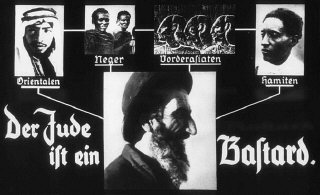
Oh okay. I get it, this is now part of the era of A.D.I. (After Don Imus). Hip Hop is now to blame for racism in Germany. The same Germany that gave us the Third Reich and the most extreme ideologies of white supremacy the world has yet seen. The Germany where the 20,000 to 30,000 blacks unfortunate enough to live under Nazi rule faced what the US Holocaust Museum termed "isolation...persecution, sterilization, medical experimentation, incarceration, brutality, and murder." The Germany responsible for the extermination of 6,000,000 Jews portrayed as some inferior "bastard offspring" of Africans and Asians. The Germany with a brutal and racist colonial legacy in Africa, including the Herero Massacre. The Germany where racist attacks (against blacks and others) had soared to over 40% by 2001; an Ethiopian-born man was beaten into a coma last April by a white mob. The Germany where black soccer players are taunted by thousands of fans who engage in "monkey chants" and throw bananas (part of a European continent wide derogatory ritual) when they enter on to the field. That's the Germany that now gets to blame Hip Hop for its racist sins.
Well, this must be a milestone in the history of creating scapegoats and irony. Even if one allows for the obvious reality that negative images of blacks is to blame for this incident, why lay it so easily at the feet of Hip Hop? Germany has a long history of Hip Hop, most of which is greatly divorced from "thug" rap. German Hip Hop has developed for such a time, that it now has its own indigenous sounds, beats, social movements and feel. There's hardly a need to form an image of Hip Hop based on "black criminals" from the Bronx when there's exposure to the creative diversity of indigenous German Hip Hop. Besides, of all the scary boogey-men the German army will have to face in the world, how do black residents of the Bronx skyrocket to the top? Did a group of blacks recently settle and form the ominous Republic of "Bronx-istan" somewhere near the Sudetenland?
Today Germany has a well established black community, the Afrodeutsche, who are a thriving part of modern German society. So in many ways, the country has come a long way from its past. And many of its citizens, black, white and Asian, can appreciate the full complexity of "The Bronx"--including the culture of Hip Hop that has been allowed to flourish on German soil. Incidents like this however, along with many others, show that Germany still has a long way to go on matters of race. Best to deal with that, rather than point a finger at Hip Hop.
Friday, April 13, 2007
The Martyrdom of Don Imus or The Devil Wears Hip Hop
Even in his demise talk show host "nappy-headed hos" Don Imus has attained a form of popular martyrdom. Read any of the many comment boards or blogs or gauge the reaction from commentators and regular citizens alike, and Imus is painted as a scapegoat—a sacrificial lamb (albeit a tainted one) that was vilified by a hypocritical black lynch mob that does not speak out equally against the use of derogatory language towards black women in rap music. Black commentator Earl Ofari Hutchinson even advocates that Don Imus is rapper Snoop Dogg’s “Frankenstein Monster." But did Don Imus really die for Hip Hop's sins? Or is the media elite protecting one of their own in order to restrict and limit our discussion? Even in his demise talk show host Don Imus has attained a form of popular martyrdom. Read any of the many comment boards or blogs or gauge the reaction from commentators and regular citizens alike, and Imus is painted as a scapegoat—a sacrificial lamb (albeit a tainted one) that was vilified by a hypocritical black lynch mob that does not speak out equally against the use of derogatory language towards black women in rap music. Imus had as much to say. "That phrase [nappy-headed hos] originated in the black community….I may be a white man, but I know that these young women and young black women all through that society are demeaned and disparaged and disrespected…by their own black men and that they are called that name." This defense has been cited repeatedly by defenders of Imus, and by those who assert it is rap music that is to blame for his slur. Increasingly conservative commentator Earl Ofari Hutchinson even advocates that Don Imus is rapper Snoop Dogg's "Frankenstein Monster." For Imus, a great deal was tolerated by CBS and MSNBC for a long time. But unlike Snoopp Dogg and the other purveyors of derogatory and sexist "thug" rap, or the radio landscape of insensitive commentary by Rush Limbaugh, Michael Savage and Laura Ingrams, Don Imus was able to have a program on mainstream television outlets that reached millions of viewers. Unlike the explicit drug-dealer glorifying Young Jeezy or the violent fictional mob boss Tony Soprano, Imus interviewed members of the media elite, presidential candidates, influence peddlers, and more. 50 Cent is derogatory in nearly every aspect of his lyricism, no doubt. But much like soft-core porn stars on Cinemax, he and other pushers of smut and violence, aren't afforded these privileges. Imus was. And when he crossed that line—wanting his cake and eat it too—he fittingly had his "ho" card pulled. Special thanks to Media Matters.org for the invaluable information.
The Martyrdom of Don Imus
or
The Devil Wears Hip Hop 
A Martyr and the Devil ?
However there is a glaring problem with the impending martyrdom of Don Imus—it rests on a series of omissions.
"Nappy Headed Hos:" Chances are if you heard the news story repeatedly, you mostly got the abridged version. Here's the larger context. Imus began by saying the women on the Rutgers team were some "rough girls" with "tattoos." It is the executive producer of the show Bernard McGuirk who interrupts to say, "Some hard-core hos." Imus responds, "That's some nappy headed-hos" and begins to compare them unfavorably to the women of the Tennessee team. McGuirk then jokes, "The Jigaboos vs the Wannabes," alluding to Spike Lee's School Daze. He and Imus go on to talk about the lack of femininity of the Rutgers players. A fellow regular on the show, sports announcer Sid Rosenberg, adds "It was a tough watch. The more I look at Rutgers, they look exactly like the Toronto Raptors." This larger context brings up an entirely different angle. What we have here are several white men indulging in an age old intersection of sexism and racism that degrades black women as either sexually exotic or physically unattractive—at least in comparison to white women. Put together, along with words like "Jigaboo," we have a story more offensive than the "nappy headed hos." But the media inexplicably leaves this context on the cutting room floor. And now our conversations and debates are restricted to, "well don't rappers use ho' too?" and "why is Imus being singled out?" Perhaps it's because "Jigaboo" wouldn't fit into the "it's the rappers fault" theme.
"Bitch is Going to be Wearing Cornrows:" Executive producer Bernard Guirk, who instigated the disastrous remarks about the Rutgers team but goes unmentioned in news stories, just weeks ago made comments that were even more inflammatory. Just one month ago, on the March 6, 2007 edition of MSNBC's Imus in the Morning, executive producer Bernard McGuirk stated that Sen. Hillary Rodham Clinton (D-NY) was "trying to sound black in front of a black audience" when she gave a speech on March 4 in Selma, Alabama, to commemorate the infamous 1965 "Bloody Sunday" Civil Rights march. McGuirk added that Clinton "will have cornrows and gold teeth before this fight with [Sen. Barack] Obama [D-IL] is over." Earlier in the program, in reference to Clinton's speech, McGuirk had said, "Bitch is gonna be wearing cornrows." McGuirk also said that Clinton will be "giving Crips signs during speeches," alluding to the infamous Los Angeles-based street gang. The entire time McGuirk is stating this, denigrating an important moment in Civil Rights history, Imus jokes along, never stating the words himself but urging on the comments and certainly never calling McGuirk out for them. Although all of this happened just a month ago, and McGuirk was intricately involved in this current controversy, somehow he escapes mention in most media depictions of the story. So, again, we are presented with no context by which people can make a sound examination of both the initial controversial event and the very recent history of the show.
"Whitey plucked you from the jungle"…and "took away your spears:" Bernard McGuirk made those statements just one month ago, on the same March 6, 2007 edition of Imus in the Morning mentioned above. He was doing a mocking imitation of African-American poet Maya Angelou. Don Imus, playing along, urges McGuirk to do his imitation of "that woman…the poet" who another guest (Rob Bartlett) compares to "Esther Rolles from Good Times." McGuirk eagerly indulges with a poem where he jokes about slavery and the stereotype of blacks being lazy: "Whitey plucked you from the jungle for too many years, Took away your pride, your dignity, and your spears, With freedom came new woes, Into whitey's world you was rudely cast, So wake up now and go to work? You can kiss my big black ass." It's only after a good laugh that Imus playfully warns McGuirk to stop because "I don't need any more columns."
"Bernard McGuirk is there to do 'nigger' jokes:" That was a quote attributed to Don Imus by producer Tom Anderson in 1998. Imus was speaking to CBS journalist Mike Wallace. At first denying that he had said so, when called to the carpet about it by Wallace, Imus laughed and admitted it—but said it was "off the record."
"That Animal [Venus Williams]….She's an Animal:" That was sports announcer Sid Rosenberg, a regular guest on the Imus show in June of 2001, talking about tennis player Venus Williams. Rosenberg was also part of the crew involved in this latest controversy [comparing the Rutgers women to a male basketball team] who disappeared from the headlines. "That animal…" Rosenberg says of Venus Williams in her appearance at the 2001 U.S. Open, "She's an animal." Commenting on the Williams sisters together, Rosenberg says, "I can't, I can't even watch them play anymore. I find it disgusting…They should play with the men." In his normal way, Imus calls this stupid, but allows Rosenberg to continue with his disparaging remarks. "A friend, he says to me, 'You know what,' he goes, 'Listen, one of these days you're going to see, find Venus and Serena Williams in Playboy.' I said, 'You gotta better shot at National Geographic." To this Imus responds, "That'll be fine." After a small furor erupted over this, Imus fired Rosenberg but re-hired him within a week after an apology was made on the air. Rosenberg would insist that his comments about the Williams sisters weren't racist, "just zoological." After a string of later offenses, including referring to Palestinians as "stinking animals" and mocking singer Kylie Minogue's cancer, Rosenberg was let go in 2005. However earlier this year he returned, and picking up on his old habit of demeaning women, especially black women, he referred to the Rutgers team as "a tough watch" and that "they look exactly like the Toronto Raptors."
As the above illustrates, the Imus show's problems with gender and race are not new. It was part of a larger pattern, one that had long been noted by others like Media Matters.org or FAIR, though glaringly overlooked by the mainstream media and tolerated by both CBS and MSNBC. Imus often walked a delicate tightrope, never straying directly into the most inflammatory remarks himself, but encouraging and allowing it from both Sid Rosenberg and Bernard McGuirk (the one hired to do "nigger jokes."). A May 30, 1996, column in The News & Observer of Raleigh, North Carolina, protesting the show's treatment of Maya Angelou, summed it up thusly:
In 2000, the show's treatment of blacks became so dismal, that African-American Chicago Tribune columnist Clarence Page appeared on the show and asked Imus to pledge to "cease all simian references [to] black athletes" and "references to noncriminal blacks as thugs, pimps, muggers, and Colt 45 drinkers." Imus responded, "I promise to do that." Page also asked that Imus put an end to black minstrel-like "Amos 'n Andy cuts," to stop the "comparison of New York City to Mogadishu," and cease with "all parodies of black voices." Imus joked, "I think Bernard should be doing this," but accepted the pledge, only to break it almost immediately.
And so the show has long operated. What was different this time was that Imus broke his own rule. Rather than letting McGuirk and Rosenberg make derogatory comments for him, he jumped into the fray, calling the Rutger's team "nappy headed hos." At first refusing to recant, when the heat was turned up he invited himself onto activist Rev. Al Sharpton's show to apologise. And it wasn't long before the media elite--from The Boston Globe's Tom Oliphant to Newsweek's Howard Fineman--rallied around him. However this time it wasn't enough. Key advertisers began to abandon him. MSNBC and CBS, perhaps fearing of opening a Pandora's Box into the show's sordid history, decided to finally cut ties with Imus and take their losses.
This has happened before. Right wing radio host Rush Limbaugh was invited in the summer of 2003 as a Sunday sports announcer for ESPN, even despite a long history of insensitive racial comments. By October of that year Limbaugh found himself mired in controversy when he made disparaging comments about black quarterback Donavan McNabb. Fearful of bad publicity, ESPN jettisoned Limbaugh quickly. Why was Limbaugh axed for what was normal fare on his radio show? Because what is usually allowed in right-wing radio commentary cannot be tolerated on a big name mainstream television station like ESPN.